

When choosing the right smart telescope, size and weight are critical factors.
Do you want a powerful piece of astrophotography equipment for your backyard, or a lightweight, “grab-and-go” device for travel?
The answer dictates which model is right for you.
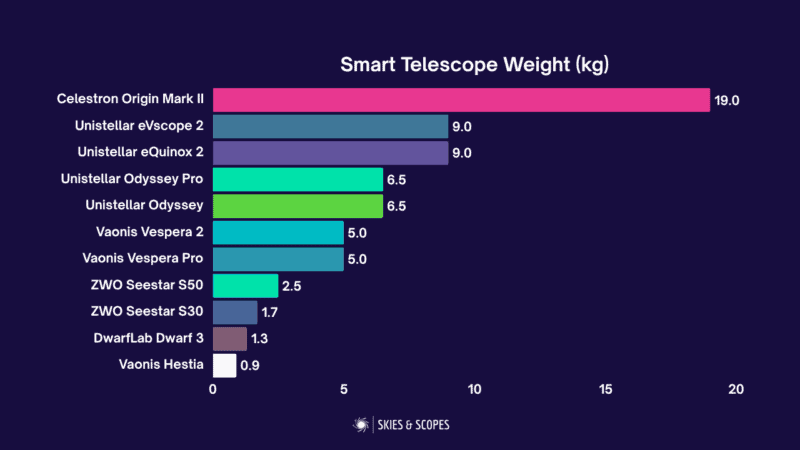
Here is a look at the smart telescope market, ranked by weight.
If you prefer, you can watch the video:
Comparison of Smart Telescope Weights
| Telescope Model | Total Weight (Approx.) | Portability Level | Primary Advantage |
| Celestron Origin Mark II | 18.9 kg (41.6 lbs) | Extremely Low | Best Astrophotography Aperture |
| Unistellar eVscope 2 / eQuinox 2 | 9 kg (19.8 lbs) | Medium | High Performance & Citizen Science |
| Vaonis Vespera 2 / Vespera Pro | 5 kg (11 lbs) | High | Automated & Sleek Design |
| Unistellar Odyssey / Odyssey Pro | 6.5 kg (14 lbs) | High | Ease of Use & Portability |
| Seestar S50 | 2.5 kg (5.5 lbs) | Very High | Excellent Budget Option |
| Seestar S30 | 1.65 kg (3.6 lbs) | Maximum | Ultra-Compact & Affordable |
| Dwarf Mini | 1.64 kg (3.6 lbs) | Maximum | Ultra-Compact & Affordable |
| Dwarf 3 | 1.3 kg (2.6 lbs) | Maximum | Lightest Dedicated Smart Scope |
The Heavyweight: Celestron Origin MK2
The Celestron Origin MK2 is a unique beast in the smart telescope category. While it offers the best specs for pure astrophotography (due to its large aperture), it weighs approximately twice as much as its next-heaviest competitors.
- Best for: Backyard use, where it can be set up once and left, or for users who prioritize the absolute best imaging performance and don’t mind the weight.
- Drawback: Its size and weight significantly limit its portability.
The Middle Ground: Unistellar and Vaonis
Models from Unistellar and Vaonis occupy the middle tiers, offering a great balance between imaging capability and manageable portability.
- Unistellar Odyssey and Pro, and the Evscope / Equinox models sit around 6.5 kg to 9 kg. They are manageable to move but are still substantial enough to provide good optical performance.
- Vaonis Vespera 2 and Pro models are lighter at ~5 kg, offering a sleeker, more automated experience that is great for throwing in a backpack or carrying to a dark-sky location.
The Ultra-Portables: Dwarf and Seestar
For maximum portability—perfect for travel, hiking, or quick setups—the budget-friendly options are the champions.
- The Dwarf 3 weighs an incredibly light 1.3 kg and is often compared to the size of a book.
- The Dwarf Mini and the two ZWO Seestar S50 and S30 models also fall into this category, being very small and easy to carry.
A Special Case: The Vaonis Hestia
You may also notice the Vaonis Hestia at the bottom of the weight rankings.
This device is not a true smart telescope as it lacks an internal camera. Instead, it uses a system of lenses and prisms to focus light directly into your smartphone’s camera sensor.
- Advantage: It is super light and battery-free (weighing under 1 kg).
- Drawback: The imaging is dependent on your phone’s camera and image stacking, meaning the results are generally not on par with the higher-end models that have dedicated internal sensors.
If you want more see our article on the best smart telescopes or watch the video below: