If you’ve been waiting for an FSQ-106EDX4, stop refreshing the stock pages.
It’s gone. Takahashi discontinued the EDX4, and the last new units sold around mid-2024.
The best Takahashi FSQ-106 alternative for most imagers is the Askar SQA106.
It’s the closest spec-for-spec match: same 106mm aperture, faster native focal ratio, full-frame sharp at prime focus, at less than half the old Tak price.
The strong runner-up is the Askar FRA600, the cheaper and more flexible pick thanks to its 0.7x reducer.
One honest point up front. Neither Askar matches the FSQ’s 88mm image circle or its f/3.6 (and f/3) reducer range.
But the SQA106’s newer optics were engineered for today’s small-pixel CMOS, and on a modern full-frame sensor they can actually behave better in the corners than the old Tak design.
This is the full breakdown: a 3-way spec table, a section on each scope, the used-FSQ reality, and a clear who-buys-which.
 “SNR G107.5-5.2, Unexpected Discovery (The Nereides Nebula in Cassiopeia)” © Marcel Drechsler, Bray Falls, Yann Sainty, Nicolas Martino and Richard Galli, winner of Astronomy Photographer of the Year 2024. Taken with a Takahashi FSQ-106EDX4.
FSQ-106EDX4 vs Askar SQA106 vs FRA600: Specs Side by Side
The fastest way to judge how close the Askars get is to line the numbers up.
| Spec | Takahashi FSQ-106EDX4 (discontinued) | Askar SQA106 | Askar FRA600 |
|---|---|---|---|
| Aperture | 106mm | 106mm | 108mm |
| Focal length | 530mm | 509mm | 600mm |
| Focal ratio | f/5 | f/4.8 | f/5.6 |
| Optical design | Modified Petzval quadruplet (2 ED) | Quintuplet Petzval (2 SD) | Petzval quintuplet (2 ED) |
| Corrected image circle | 88mm | 55mm | 66mm |
| Focuser | 4in rack-and-pinion, 10:1 | 2.8in dual-speed Crayford, motorisable | 4.2in Crayford rack-and-pinion, 1:10 |
| Back focus | 178mm | 48-78mm (55mm rec.) | 160mm |
| OTA weight | 7.0kg | 5.82kg | 6.5kg (with rings) |
| Reducer options | f/3.6 and f/3, down to 320mm | none | 0.7x to 420mm f/3.9 |
| Price | Was $7,330 / £6,845, now used-only ~$5,000-$9,500 | $3,395 / £3,395 | $2,599 / £2,699 OTA + reducer ~$439 / £410 |
Three numbers matter most for a Tak shopper.
The SQA106 is faster natively (f/4.8 versus f/5) and the lightest of the three at 5.82kg.
The FRA600 carries far more back focus (160mm) for a deep imaging train with filter wheel, tilt plate and OAG.
And only the Tak reaches an 88mm circle and an f/3 reducer.
On paper the SQA106 is the nearest thing to a like-for-like swap. The FRA600 trades that spec-match for a second focal length.
Takahashi FSQ-106EDX4: The Benchmark You Can Only Buy Used
Discontinuation usually tanks prices. It didn’t here.
Used EDX4 units still ask between $5,000 and $9,500 on Astromart, with one 2021 example listed at $9,500.
The scope you can no longer buy new still costs Takahashi money.
It earned that loyalty. Here’s what made it the benchmark:
- An 88mm image circle, the largest in its class and big enough to cover medium format.
- A reducer range from f/5 down to f/3.6 and f/3, which nothing in current production matches.
- A four-inch rack-and-pinion focuser and 178mm of back focus.
- Japanese build quality with near-zero copy-to-copy variation.
Many practitioners call it the best astrophotography telescope outside a professional observatory.
Takahashi is one of the most common names in our Astronomy Photographer of the Year equipment analysis, and resale stays strong for the same reasons.
The honest weakness is the one that sets up everything below. The Petzval design predates modern small-pixel CMOS.
Run an f/3.6 reducer onto a 3.76µm sensor like the ASI6200 and the critical focus zone gets very thin.
As one CloudyNights imager put it, “the CFZ is really thin at f3.6 and these tiny pixels are not forgiving”.
Tilt and coma show up fast in the corners.
On top of that it’s the heaviest here at 7.0kg, and with production ended there’s no warranty and no factory service.
The EDX4 is used-only now. If you specifically need the 88mm circle or f/3 reduction, the used-market section below is for you.
- Best for: imagers who genuinely need 88mm coverage or f/3 reduction and accept used-market risk.
- Skip if: you want a warranty, new stock, or optics built for today’s small pixels.
 “The Scream of a Dying Star” © Yann Sainty, shortlisted in Astronomy Photographer of the Year 2024. Taken with a Takahashi FSQ106EDX4.
Askar SQA106: The Closest Replacement for the FSQ-106
If you wanted an FSQ-106 for full-frame deep-sky at prime focus, the SQA106 is the nearest thing on sale, and it costs less than half the last Tak retail at $3,395 / £3,395.
You can check current SQA106 prices here.
The spec-for-spec case is strong:
- The same 106mm aperture as the Tak, at a faster native f/4.8 (against the FSQ’s f/5).
- A 509mm focal length that sits almost on top of the Tak’s 530mm.
- A quintuplet Petzval design with two SD (super-low-dispersion) glass elements, a step up from ED.
- Self-flattening optics, so no reducer or flattener is needed for full-frame.
- The lightest of the three at 5.82kg, with a 360-degree graduated rotator in the box.
This is where the recommendation comes from.
Askar’s optical data, corroborated by independent testing at deep-space-astronomy.ch, puts the corner star RMS spot below 2.2µm across full-frame.
That’s smaller than an IMX455 pixel (3.76µm) and far smaller than an IMX410 pixel (4.78µm). The optics are not the limiting factor on any modern full-frame camera.
The SD glass means stars show “almost no evidence of chromaticism on the stars, even in the corners”.
Trevor at AstroBackyard was “super impressed”, and a 365Telescopes reviewer found it “pin sharp across the field” and bought the unit after testing.
The caveats are real and worth your attention:
- The corrected image circle is 55mm, not 88mm. No medium-format edge-to-edge.
- There’s no dedicated reducer, so you’re locked at 509mm f/4.8.
- Back focus is a tight 48-78mm, which may not fit a filter wheel, tilt plate and OAG together.
- At f/4.8 an autofocuser is a practical necessity, not a luxury.
- Chinese manufacturing means more copy-to-copy variation than Takahashi’s near-perfection.
For a full-frame imager who wants to attach a camera and shoot, the SQA106 is the FSQ-106 replacement. It’s the one I’d buy.
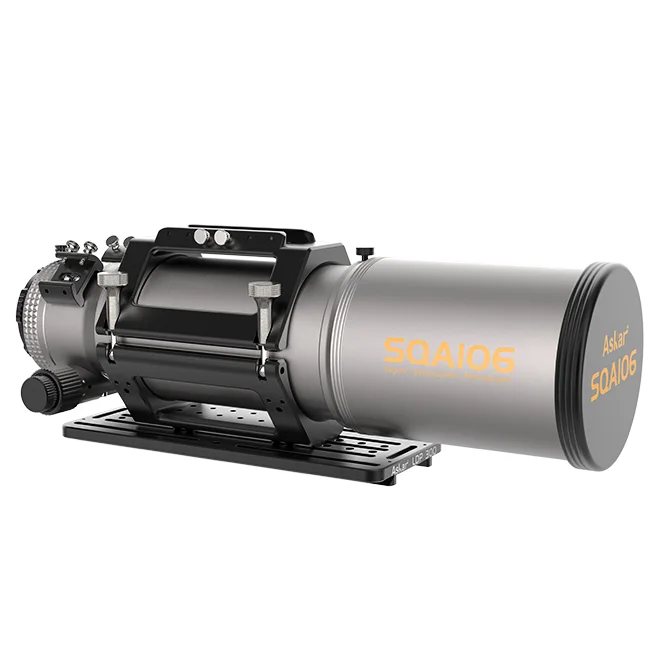 The Askar SQA106: self-flattening, full-frame sharp at f/4.8, and under half the old Takahashi price.
Askar FRA600: The Faster, Cheaper, Two-in-One Alternative
There’s a way to get two complete focal ratios out of one scope for less than the SQA106 costs on its own. That’s the FRA600 plus its 0.7x reducer.
The OTA is $2,599 / £2,699, the reducer runs about $439 / £410, and the system total lands near $3,038 against the SQA106’s $3,395.
You can check current FRA600 prices here.
Native, it’s a 600mm f/5.6 scope with a 66mm corrected image circle and a generous 160mm back focus, the most in this comparison, which swallows a filter wheel, tilt plate and OAG with room to spare.
The focuser is a 4.2-inch Crayford in the same class as the Tak.
Thread on the 0.7x reducer and it becomes a 420mm f/3.9 instrument.
That’s roughly double the photon collection (so halved exposures), about 1.43x wider field, and, counter-intuitively, sharper stars.
Independent testing measured roughly a 20% improvement in stellar FWHM with the reducer fitted versus native, and no glare on bright stars where some Takahashi correctors flare.
The trade-offs:
- Native f/5.6 full-frame corners are only “marginally acceptable”, with tangentially stretched stars. For full-frame you really want the reducer fitted.
- The reducer adds slight lateral chromatic aberration that needs layer separation in post (fine for narrowband).
- ED-only glass means more edge colour than the SQA106’s SD.
- There’s a minor internal reflection on Sirius-class stars, and it’s heavier than the SQA106.
- Stock comes and goes; it’s periodically out at US retailers.
So:
- Best for: imagers who want two focal lengths, the fastest f-ratio here (f/3.9), a deep imaging train, or the lowest entry price.
- Skip if: you want one-and-done full-frame sharpness with zero chroma work in post. The SQA106 does that better.
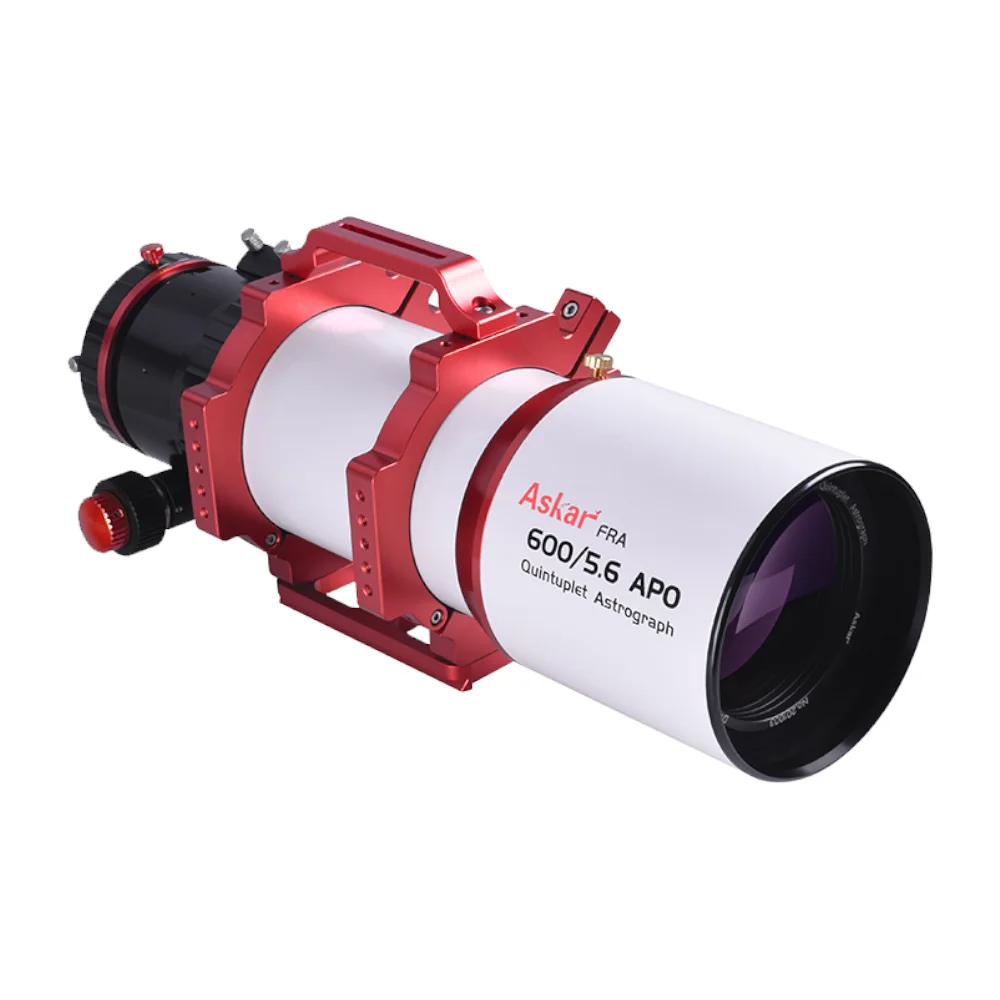 The Askar FRA600: 600mm f/5.6 native, or 420mm f/3.9 with the 0.7x reducer fitted.
That 88mm Image Circle: Does It Still Matter on Modern Sensors?
The 88mm circle is real. But unless you shoot a medium-format sensor, it’s coverage you’ll never use.
A full-frame sensor’s diagonal is only 44mm, comfortably inside even the SQA106’s 55mm corrected circle.
The number that sells the Tak is mostly headroom your camera can’t reach.
Here’s what tips the SQA106 into the modern pick. The FSQ’s Petzval design was drawn decades ago for cameras with large pixels.
As CloudyNights regulars note, “the current Petzval designs from Televue and Takahashi were designed many years ago for use with cameras with large pixels”, whereas Askar drew the SQA106 around small-pixel CMOS from the start.
That design gap shows up where it counts.
At f/3.6 the Tak’s critical focus zone is so thin that tilt and coma show on 3.76µm pixels, the kind in a ZWO ASI6200.
The SQA106’s sub-2.2µm corner spots stay smaller than that same pixel, so the optics drop out of the equation and seeing becomes your limit, not the glass.
You’re not trading down on sharpness. You’re trading down on coverage you don’t use.
The boundary is genuine, though. If you really do shoot a 33x44mm medium-format sensor like a QHY600 or a Nikon Z7, the 88mm circle is still unmatched.
The SQA106 reaches roughly 90% illumination at the 44mm mark before its corners degrade, and even the FRA600’s wider 66mm circle falls short of edge-to-edge on that format.
Both Askars give up the far medium-format corners the Tak holds onto.
For the full-frame and APS-C cameras most of us actually own, the SQA106’s newer optics are the safer bet, not a compromise.
Should You Just Buy a Used FSQ-106 Instead?
A used FSQ-106EDX4 is not the bargain you’d hope.
Asking prices run from $5,000 to $9,500, with no warranty and no manufacturer service now that production has ended.
You’re buying a scope you can’t get fixed.
Run the maths. That’s 1.5x to nearly 3x the price of a new SQA106 at $3,395, for a discontinued instrument.
And the reducer you’d need for fast widefield isn’t included, so budget $500 to $1,000 more on top of the OTA before you’re shooting at f/3.6.
For full-frame imaging at prime focus, the new Askar is both cheaper and a sharper match to your sensor.
Used still wins in two cases, and only two. You need the 88mm medium-format circle, or you need the f/3.6 / f/3 reducer range no current scope matches.
If that’s you, hunt carefully:
- Confirm it’s an EDX4, not an older EDX3 or a fluorite N model. They look similar and the older optics behave differently.
- Budget extra for the right reducer; the 645RD QE0.72X is the one that reaches a 60mm medium-format circle.
- Accept that f/3.6 reduction demands a tilt plate and careful alignment with any small-pixel sensor.
If you need medium-format or f/3, hunt a clean used EDX4.
For everyone else, new Askar money buys a warranty and a closer match to your sensor.
Which One Should You Buy? A Decision Guide for FSQ Shoppers
Skip the agonising. Match yourself to a line below and you’ve got your answer.
- Full-frame, want plug-and-image simplicity → Askar SQA106. Attach the camera, shoot, done. No reducer or flattener to buy.
- Want two focal lengths or the fastest f-ratio (f/3.9) → Askar FRA600 plus the 0.7x reducer. One tube covers 600mm f/5.6 and 420mm f/3.9.
- Deep imaging train (filter wheel + tilt + OAG) needing lots of back focus → FRA600, on 160mm of back focus against the SQA106’s 48-78mm.
- APS-C only and budget-led → FRA600 OTA, the cheapest entry point here at $2,599. All three are pinpoint to the APS-C corner, so you lose nothing on that format.
- Hate post-processing chroma correction → SQA106, with its cleaner SD glass and no lateral colour to layer-separate in post.
- Narrowband on big emission targets, want it fast → FRA600 with the reducer at f/3.9 halves your exposures, and the slight reducer chroma barely matters in mono narrowband.
- Must have 88mm medium-format coverage or f/3 reduction → a used FSQ-106 (see the used section above; no current scope matches it).
Two of those lines point at the SQA106, three at the FRA600, and one at the used Tak.
For most people reading this, weighing simplicity against flexibility, the answer is the SQA106. Here’s the full call.
The Verdict: The Askar SQA106 Is the FSQ-106 Replacement to Buy
The Askar SQA106 is the closest, cleanest replacement for the discontinued FSQ-106EDX4 for the full-frame deep-sky imager, at under half the old Tak price, and it’s the one I’d buy.
You can check current SQA106 prices here.
The case holds all the way through: a near spec-match at 106mm and f/4.8, sub-2.2µm corners that out-resolve your pixels, self-flattening optics, and a design built for modern sensors rather than the large pixels of twenty years ago.
The runner-up isn’t second-best so much as different-best.
The Askar FRA600 plus its 0.7x reducer is the value and flexibility pick: two focal lengths, the fastest f-ratio here at f/3.9, the deepest back focus at 160mm, and the lowest entry price.
Fit the reducer and its corners close most of the gap on the SQA106.
One honest caveat stays standing. If you truly need the 88mm medium-format circle or f/3.6 reduction, no new scope matches the FSQ-106, and a clean used EDX4 (used-only) is still the only route.
For everyone shooting full-frame or smaller, that’s coverage you’ll never miss.
Takahashi FSQ-106 Alternatives: Frequently Asked Questions
Is the Takahashi FSQ-106EDX4 really discontinued?
Yes. Astronomics states it’s “discontinued and no longer for sale”, Telescopes.net flags it DISCONTINUED in the listing title, and First Light Optics shows “Unavailable, please contact us”. Only the FSQ-85 and FSQ-130 remain in production, and the last new units are believed to have sold around mid-2024.
Does the Askar SQA106 need a reducer or flattener for full-frame?
No. The SQA106 is self-flattening. You attach the camera directly at the recommended 55mm back focus and shoot, with no separate reducer or flattener to buy. That’s its main practical edge over scopes that need extra optics.
Which Askar is the best FSQ-106 alternative for a ZWO ASI6200MM?
The SQA106. Its corner RMS spot below 2.2µm is sub-pixel on the ASI6200’s 3.76µm IMX455 sensor, so the optics aren’t the limiting factor. The SQA106 was designed around modern CMOS, whereas the FSQ at f/3.6 demands precise tilt correction with pixels that small.
Can the FRA600 match the SQA106 on full-frame corners?
Not natively. Native FRA600 full-frame corners are only marginally acceptable, with tangentially stretched stars. Fit the 0.7x reducer and the corners tighten close to the SQA106, at a faster f/3.9.
Is a used FSQ-106 worth buying versus a new SQA106?
Only for specific needs. A used EDX4 at $5,000 to $9,500 with no warranty costs well above a new SQA106 at $3,395. It’s worth it if you need the 88mm medium-format circle or f/3.6 / f/3 reduction. Otherwise the new Askar is better value and a sharper match to your sensor.
Does the FRA600 0.7x reducer work on full-frame?
Yes. The reducer is designed for full-frame, giving 420mm at f/3.9 with a corrected, fully illuminated field. Expect roughly 10% light loss at the extreme edges, which flat frames clean up, and near-round stars across the frame.