Camera resolution (measured in megapixels, or MP) is a crucial factor in determining the quality and detail of the final image produced by a smart telescope.
A higher MP count generally translates to sharper, larger images that hold more intricate detail when zoomed in.
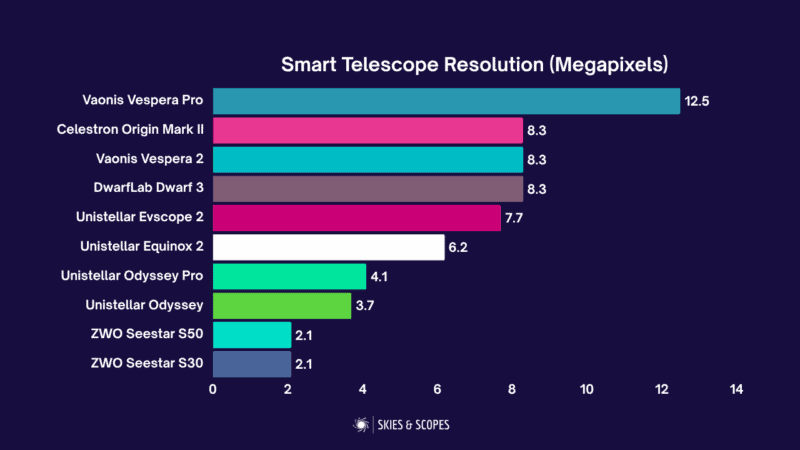
Here is a comparison of the top smart telescope models, ranked by their native camera resolution.

Camera Resolution Rankings
| Smart Telescope Model | Camera Resolution (MP) | Sensor Used | Primary Strength |
| Vaonis Vespera Pro | 12.5 MP | Sony IMX 676 | Highest Native Resolution |
| Celestron Origin MK2 | 8.3 MP | Sony IMX 678 | Top Aperture / High Resolution |
| Vaonis Vespera 2 | 8.3 MP | Sony IMX 585 | Sleek Design / High Resolution |
| Dwarf 3 | 8.0 MP | Sony IMX 678 | Ultra-Portable / Great Resolution |
| Unistellar eVscope 2 | 7.7 MP | Sony IMX 347 | Premium Features / Eyepiece |
| ZWO Seestar S50 | $\approx$ 2.1 MP | Sony IMX 462 | Budget & Portability |
| ZWO Seestar S30 | $\approx$ 2.0 MP | Sony IMX 662 | Most Affordable & Compact |
The Resolution Leader: Vespera Pro
The Vaonis Vespera Pro takes the crown for native resolution, utilizing the new Sony IMX 676 sensor to achieve an impressive 12.5 megapixels.
The High-Performance Tier
A cluster of models sits in the highly capable 8-megapixel range, utilizing excellent modern sensors:
- Celestron Origin MK2: Upgraded to 8.3 MP (Sony IMX 678), balancing high resolution with a massive 6-inch aperture.
- Vaonis Vespera 2: Also at 8.3 MP, offering a compact body with excellent imaging power.
- Dwarf 3: A popular budget option that punches well above its weight with a strong 8.0 MP camera, making it one of the best choices for resolution-per-pound.
The Budget & Portability Tier
The excellent budget smart telescopes from ZWO, the Seestar S50 and S30, feature the lowest megapixel counts (around 2 MP).
Resolution is Not Everything
It is crucial to remember that camera resolution is only one component of a great astrophotography image:
- Aperture (Light Collection): The Celestron Origin MK2 still has the largest aperture (152mm) by far, meaning it gathers significantly more light than all other models, including the Vespera Pro. This allows it to capture fainter details in less time.
- Ease of Use: Models like the Vaonis and Dwarf excel in “grab-and-go” simplicity, which many users prefer over having maximum resolution.
If you want more see our article on the best smart telescopes or watch the video below: